
A Surgeon & Buyer’s Guide to Medical Grade Stainless Steel: AISI 410 vs. AISI 420 vs. Titanium
Understanding Metallurgy, Corrosion Resistance, and Rockwell Hardness (HRC) in Precision Surgical Manufacturing
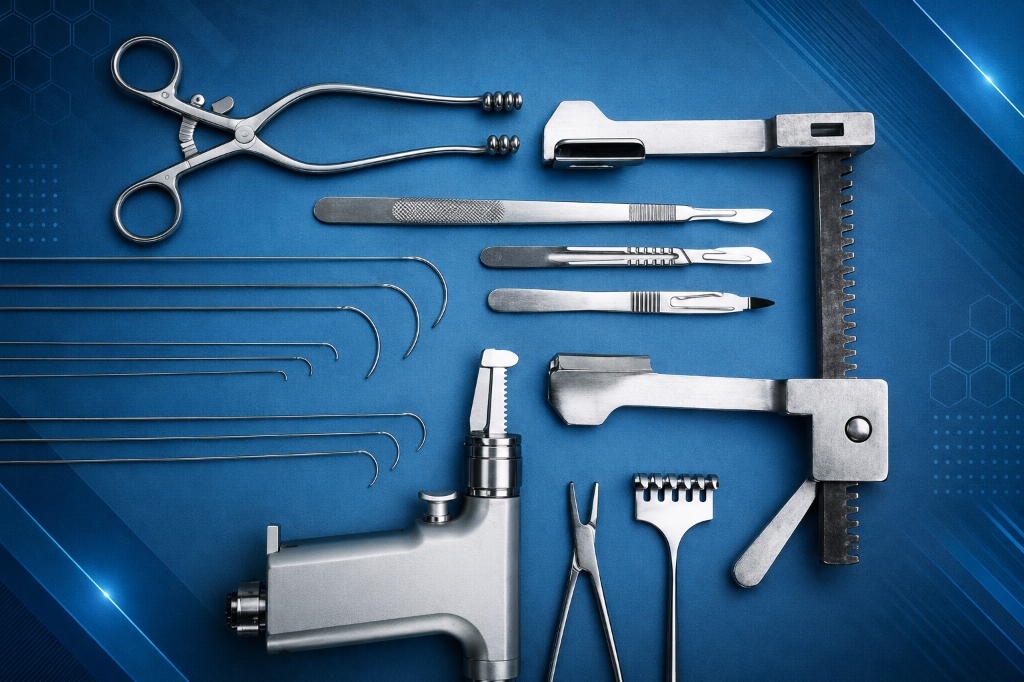
In high-precision surgical procedures, the tactile response, durability, and corrosion resistance of an instrument depend fundamentally on its metallurgical alloy. For international hospital procurement officers, distributors, and surgeons, understanding the differences between AISI 410, AISI 420, and Grade 4 Titanium is critical to ensuring patient safety and instrument longevity.
AISI 410 is a martensitic stainless steel featuring approximately 11.5% to 13.5% chromium. It is primarily utilized in instruments requiring moderate corrosion resistance with high tensile strength, such as hemostatic artery forceps, retractor frames, and speculums. When properly heat-treated, AISI 410 provides the ideal flexibility to prevent brittle micro-fractures under repetitive mechanical stress.
In contrast, AISI 420 contains a higher carbon content (minimum 0.15%), allowing it to achieve a significantly higher Rockwell hardness rating (50–55 HRC). This makes AISI 420 the global gold standard for cutting instruments including Mayo dissecting scissors, bone chisels, and bone cutting rongeurs. The increased hardness ensures that razor-sharp cutting edges remain keen across hundreds of surgical procedures and autoclave sterilization cycles.
For specialized microsurgery and orthopedics, Titanium Grade 4 and Tungsten Carbide (TC) inserts offer superior non-magnetic, non-glare properties. SubMedOrtho integrates cross-serrated TC inserts into needle holders and micro scissors, eliminating needle rotation and slippage during critical vascular suturing.
Every instrument manufactured at SubMedOrtho undergoes ASTM A967 chemical nitric acid passivation, creating an impervious chromium oxide passive layer that protects against pitting and staining during harsh steam autoclave sterilization.
All instruments mentioned in this technical paper are manufactured in accordance with strict dimensional blueprints, ASTM stainless steel standards, and batch hardness testing protocols in Sialkot, Pakistan.